
Precision Machined Spacers and CNC Components for Electric Vehicles
SpacerMFG manufactures custom turned and milled hardware for electric vehicle applications, from prototype development through repeat production runs.
We produce precision aluminum spacers, stainless steel sleeves, brass standoffs, and turned pins strictly to your engineering drawings and material specifications.
±0.005 mm
Tight tolerance capability
800 mm
Maximum milling length
24 hr
Quote review target
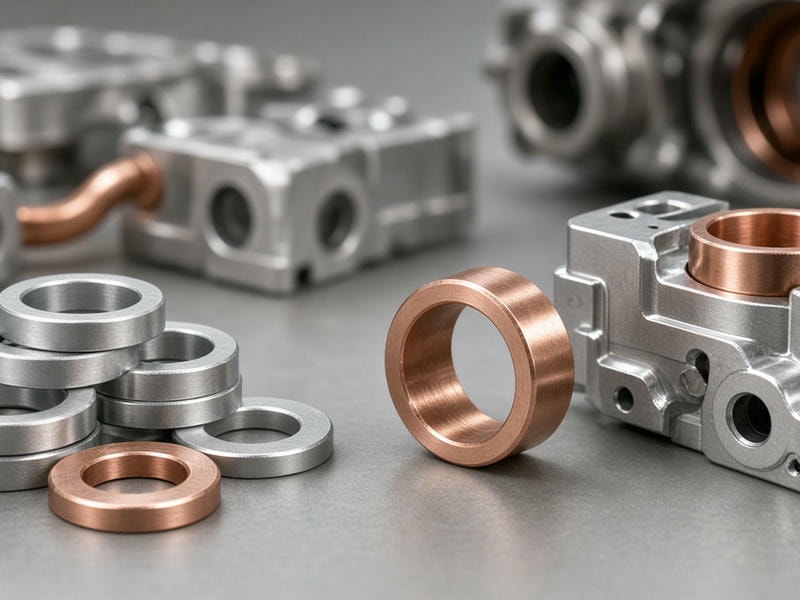
Built to print
Custom geometry, materials, tolerances, and finishes.
EV-ready control
Clean, burr-free parts for high-voltage assemblies.
Designed for EV architectures
Engineering requirements for machined hardware in EV assemblies
Electric vehicle assemblies demand tight tolerances, precise material control, and clean burr-free surfaces to maintain mechanical integrity and electrical isolation.
Battery enclosure and cell module spacing
Machined aluminum and insulated anodized spacers maintain exact stack-up dimensions, consistent clearance, thermal expansion allowances, and physical separation between high-voltage busbars and structural frames.
Power electronics and inverter mounting
Threaded male-female standoffs and precision sleeves support board-to-chassis clearances, help prevent PCB warping under torque, and provide reliable grounding paths where specified.
Electric drive units and e-axles
Steel and stainless steel sleeves and bushings with tight concentricity and perpendicularity position shafts, maintain bearing alignment, and resist high radial forces.
Production capability
CNC machining capabilities for EV components
SpacerMFG operates high-precision CNC turning lathes, Swiss-type screw machines, and CNC vertical machining centers for small-batch prototypes and scalable volume production.
Production range
- Prototype samples: 1–10 pieces
- Medium production: 100–1,000 pieces
- Turning diameter: typically 2.0–150.0 mm
- Turning length: up to 300.0 mm, geometry dependent
CNC turning specifications
| Component types | Solid and stepped spacers, threaded standoffs, sleeves, bushings, pins, shafts |
|---|---|
| Machining tolerances | Standard ±0.02 mm; tight tolerance up to ±0.005 mm, drawing dependent |
| Concentricity and runout | Controlled through single-operation multi-turret turning or secondary grinding |
| Surface finish | Ra 0.8 µm as-machined; Ra 0.2 µm with secondary centerless grinding |
CNC milling specifications
| Component types | Mounting brackets, flanged spacers, heat-sink spacers, terminal blocks, housing covers |
|---|---|
| Machining envelope | Up to 800 mm × 500 mm × 400 mm |
| Machined features | Cross-holes, keyway slots, counterbores, lightweighting pockets, custom threads |
| Positioning accuracy | ±0.01 mm |
Built to print
EV component production specifications
Custom components are produced to your drawings for EV powertrain, chassis, battery, and electronics projects.
| Component | Common materials | Key machining attributes | EV application |
|---|---|---|---|
| Battery module spacers | Aluminum 6061-T6, 7075-T6 | Flatness < 0.02 mm; hard anodized for dielectric breakdown strength | Module stack-up and cell spacing |
| Threaded standoffs | Brass CZ121, Stainless 304 | Micro-tapped threads; no burrs at thread entrance or exit | Inverter PCB mounting and ECU enclosures |
| High-strength sleeves | Carbon Steel 4140, Stainless 316 | Precision-ground OD and ID; tight wall thickness tolerance | Suspension pivots and chassis mounts |
| Terminal isolation bushings | Brass, Copper, PEEK, POM | High surface finish and zero chip contamination | High-voltage busbar connections |
| Stepped motor spacers | Stainless Steel 303, Aluminum 2024 | Single-setup turned step profiles and strict perpendicularity | E-motor end-bell assembly |
Material engineering
Material selection and finishing options
The correct alloy and surface conversion treatment helps prevent galvanic corrosion, ensure dielectric strength, and optimize weight in EV hardware.
Aluminum
Weight reduction for structural battery spacers, module covers, and brackets.
Type II / Type III anodizing
Stainless steel
High strength and corrosion resistance for cooling connections and structural joints.
ASTM A967 passivation
Brass and copper
Electrical conductivity for terminal connectors, grounding posts, and busbar hardware.
Tin / nickel plating
Raw materials for demanding EV assemblies
Aluminum alloys
6061-T6, 7075-T6, and 2024 for mass-sensitive structural parts.
Stainless steel
304, 316/316L, and 303 for corrosive or high-load environments.
Carbon and alloy steels
1018 and 4140 for drivetrain sleeves and hardened bushings.
Copper and brass
C36000 and C11000 for conductive connection hardware.
Surface finishing and post-processing
- Hard anodizing: insulation and wear resistance for aluminum.
- Passivation: free-iron removal from stainless surfaces.
- Nickel plating: uniform corrosion protection on complex geometries.
- Zinc plating: automotive corrosion protection for steel parts.
- Laser marking: part numbers, QR codes, and lot traceability.
Quality verification
Inspection controls for automotive and EV supply chains
Structured inspection checkpoints help parts fit right the first time, support automated assembly speeds, and reduce the risk of field failures.
-
1
Incoming material verification
Spectral material composition verification and mill test reports for raw bar stock.
-
2
In-process dimensional control
FAI and periodic checks for diameters, bores, thread pitches, and overall length.
-
3
Deburring and cleanliness control
Mechanical deburring, ultrasonic cleaning, and visual inspection to remove flakes and loose burrs.
-
4
Final inspection and documentation
Dimensional reports using optical comparators, CMMs, thread gauges, and micrometers.
Prototype or production quote
Send your EV component drawings for engineering review
If you are developing a new EV battery system, inverter housing, or chassis module, send your technical drawings directly to our engineering team for evaluation.
Drawing formats accepted
- 3D models: STEP, STP, IGES, IGS, SolidWorks SLDPRT
- 2D drawings: PDF, DWG, DXF
- Drawings should include explicit tolerances, material specifications, and finish requirements.
How to get started
- 1
Submit your drawings, target quantities, and material specifications to info@spacermfg.com.
- 2
Our engineering team reviews your design for manufacturability and prepares a competitive commercial quote within 24 hours.
- 3
After approval, prototype samples or initial production batches are manufactured and shipped from our Shenzhen facility.