
Precision CNC isolation components
Custom Machined Isolation Spacers to Your Drawing Specifications
SpacerMFG manufactures custom isolation spacers for industrial automation, robotics, medical devices, electronics, and heavy machinery OEMs.
When your assembly requires electrical insulation, thermal breaks, vibration damping, or protection against galvanic corrosion, we machine parts directly to your 2D drawings and 3D models.
10–50,000+
Prototype to production quantities
±0.01 mm
Precision dimensional capability
2–300 mm
Standard outer diameter range
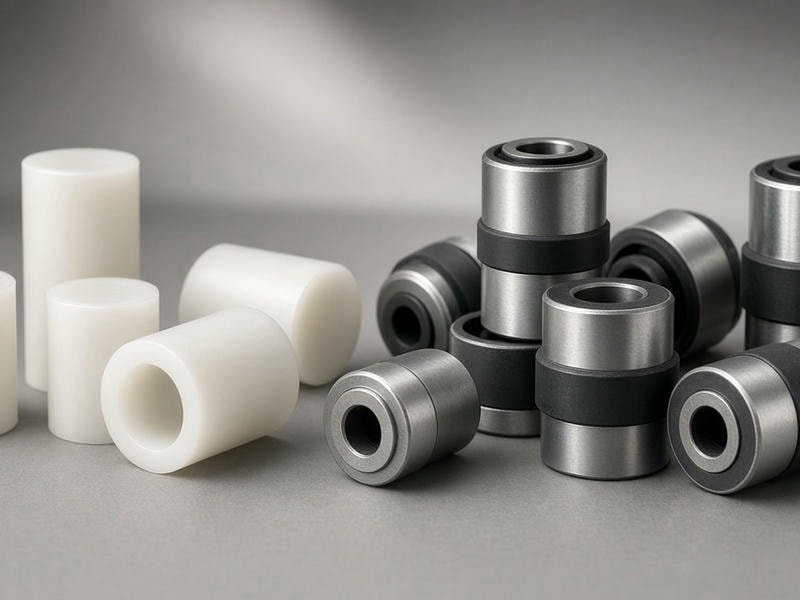
Drawing-driven production
Parts made to your dimensions, tolerances, and finish.
Engineering review
DFM feedback before production begins.
Built around your application
Isolation performance starts with the right material
The term isolation covers several distinct engineering functions. We machine non-conductive polymers and surface-treated metals according to your thermal, electrical, chemical, and mechanical requirements.
Discuss your material choiceElectrical insulation
POM, PEEK, PTFE, and Nylon provide non-conductive separation and low thermal conductivity.
Thermal breaks
PTFE, PEEK, and hard-anodized aluminum help manage heat transfer while maintaining assembly strength.
Galvanic protection
Passivated stainless steel and anodized aluminum help separate dissimilar metals and limit corrosion.
Technical specifications
Manufacturing limits for precision isolation spacers
We produce solid, stepped, flanged, and threaded isolation spacers according to your specified geometry, material, and tolerance requirements.
| Feature / Parameter | Standard capability | Precision capability |
|---|---|---|
| Outer diameter (OD) | 2.0 mm to 300 mm | ±0.01 mm (±0.0004 in) |
| Inner diameter (ID) | 1.0 mm to 280 mm | ±0.01 mm (±0.0004 in) |
| Length / thickness | 1.5 mm to 400 mm | ±0.02 mm (±0.0008 in) |
| Concentricity | 0.02 mm | 0.005 mm |
| Surface roughness | Ra 1.6 μm | Ra 0.4 μm, ground or polished |
| Primary materials | Engineering plastics, aluminum, stainless steel, carbon steel, and brass | |
| Secondary processes | Drilling, tapping, reaming, anodizing, passivation, and laser marking | |
Material selection
Select the right isolation strategy
Engineering plastics
POM: Dimensionally stable and easy to machine. PEEK: Continuous use up to 260°C with high strength and chemical resistance. PTFE: Excellent dielectric performance and chemical resistance. Nylon: Cost-effective wear resistance and impact dampening.
Aluminum with insulating coatings
6061-T6 and 7075-T6 aluminum provide lightweight structural rigidity. Type III hardcoat anodizing creates a 25–50 μm aluminum oxide layer that acts as a dielectric barrier.
Stainless steel and metal alloys
304 and 316L stainless steel suit marine, chemical processing, and medical equipment. ASTM A967 passivation removes free iron and helps prevent galvanic reactions.
Common configurations
Machined to function, not just to fit
Every component is made to your drawing rather than supplied as off-the-shelf standard hardware.
- 01
Stepped isolation spacers
Seat inside a larger mounting bore while retaining a smaller fastener diameter.
- 02
Flanged isolation sleeves
Isolate both the radial bore and axial face of a fastener or pin.
- 03
Threaded isolation standoffs
Internal or external threads maintain mechanical spacing and electrical clearance.
- 04
Precision rings and washers
Flat, parallel spacers maintain precise air gaps or axial alignment.
CNC process controls
A controlled path from raw stock to dispatch
SpacerMFG operates a Shenzhen-based machining facility equipped with multi-axis CNC lathes, Swiss-type automatic lathes, and 3/4-axis CNC milling centers.
01
Raw material
Plastics and metals
02
CNC machining
Turning and milling
03
Secondary work
Reaming and finishing
04
QC inspection
CMM and optical checks
05
Dispatch
Verified parts shipped
Manufacturing expertise
Process capability for demanding assemblies
CNC turning and Swiss machining
- High-speed turning for high-volume cylindrical spacers.
- Swiss turning for thin-wall sleeves and micro-spacers down to 2.0 mm diameter.
- Single-setup internal threads, external grooves, chamfers, and burr control.
CNC milling and boring
- Non-round mounting flanges, bolt-hole circles, slotting, and alignment flats.
- Internal reaming for strict hole-size control.
- Press-fit and slip-fit bores produced to assembly requirements.
Secondary operations
- Mechanical and manual deburring for clean seating surfaces.
- Type II or Type III hardcoat anodizing in clear, black, or custom colors.
- Laser marking for part numbers, batch codes, and alignment marks.
Application fit
Is custom machining right for your project?
Custom isolation spacers are a strong fit when geometry, material performance, or repeatability exceeds standard hardware options.
Choose custom machining when
- Non-standard wall thicknesses, lengths, or OD/ID combinations are required.
- Concentricity of ≤0.01 mm supports high-RPM shafts or precision guides.
- Stepped or flanged geometry combines isolation and positioning.
- PEEK, PTFE, or hard-anodized metals are needed for severe conditions.
Standard hardware may suit when
- Wide-tolerance nylon washers meet the assembly requirement.
- Dimensional consistency is not critical in a low-cost application.
- Only simple flat separation is needed.
- The assembly remains indoors at room temperature.
Quality assurance
Tolerance compliance verified before shipping
Each order is checked against the dimensional, material, and documentation requirements defined for your project.
- 1
Incoming material verification
Spectral analysis for metal alloys and material certification for engineering plastics.
- 2
In-process inspection
First-piece inspection and scheduled sampling verify OD, ID, length, and thread pitch.
- 3
Final inspection
Optical measuring systems and CMM inspection check concentricity, perpendicularity, and parallelism.
- 4
Full documentation
Material test reports, certificates of conformance, and dimensional inspection reports are available upon request.
Request a quote
Send your isolation spacer requirements to our engineering team
Provide your project details for a price quote, lead time estimate, and design-for-manufacturability review.
- 2D / 3D CAD files: STEP, IGES, X_T, or PDF formats with dimensions and tolerances.
- Material specification: For example, POM-H, PEEK 450G, or 6061-T6 aluminum.
- Surface finish or coating: As-machined, Type III hardcoat anodized, passivated, or specified alternative.
- Quantity: Prototype batch size or production run requirements.
Contact details
Email: info@spacermfg.com
Facility:
Business hours: Monday–Saturday, 8:00 AM–6:00 PM (UTC+8)
Start your engineering review
Share your drawings and requirements through the contact channel below.
Our team can review material, tolerance, geometry, quantity, and finishing requirements before production.