
Precision CNC Manufacturing
Precision CNC Milling Services for Custom Components & Assemblies
SpacerMFG manufactures custom precision milled parts, mounting brackets, aluminum blocks, and multi-feature industrial components directly from customer engineering drawings.
Based in Shenzhen, China, we support equipment OEMs, automation integrators, and product development teams with rapid prototypes and repeat production runs.
Send your 2D and 3D drawings for technical review and quotation within 24 hours.
Technical capacity
CNC milling built around your drawing requirements
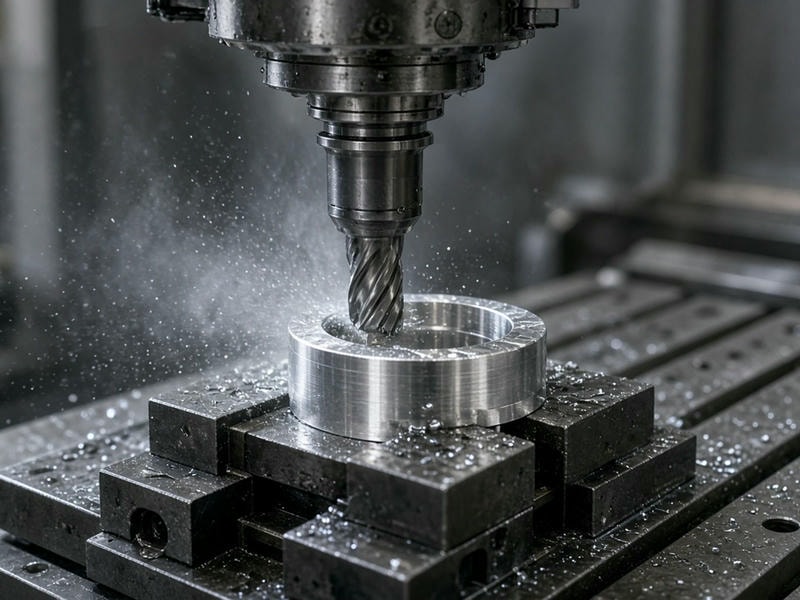
Our milling department processes raw bar stock, plate, and pre-machined blanks into tight-tolerance components. We handle simple prismatic geometry alongside complex 3D surface contours, deep pockets, threaded holes, and secondary grinding.
| Component Types | Precision mounting brackets, manifold blocks, enclosure housings, slotted plates, stepped spacers, custom fixtures |
|---|---|
| Machining Materials | Aluminum 6061-T6, 7075-T6, 5052; stainless steel 304, 316L, 17-4 PH; carbon and alloy steel; brass, copper, POM/Acetal, PEEK, and Nylon |
| Machined Features | Internal and external pockets, T-slots, cross-drilled holes, precision counterbores, multi-axis profiles, and internal or external threads |
| Tolerances | ISO 2768-m/f or custom tight tolerances down to ±0.01 mm depending on geometry |
| Surface Roughness | As-machined Ra 1.6 µm standard; finer finishes down to Ra 0.8 µm through grinding or polishing |
| Production Volume | Rapid prototypes from 1–10 pieces, low-volume production from 100–1,000 pieces, and repeat production orders |
| Secondary Operations | Precision drilling, tapping, deburring, surface grinding, anodizing, passivation, and laser marking |
Made to print
Milled components for demanding assemblies
Every component category is produced to the exact dimensions, datum references, material specifications, and finish callouts shown on your engineering documentation.
Mounting Brackets & Structural Plates
Custom structural brackets, sensor mounts, and motor adapter plates with flat datum surfaces, precise hole patterns, and weight-reduction pockets.
Manifold & Valve Blocks
Hydraulic and pneumatic blocks with intersecting fluid channels, O-ring groove seats, and high-pressure threaded ports.
Custom Milled Spacers & Flanged Components
Non-rotational spacers, stepped alignment blocks, and flanged standoffs with side-milled flats, keyways, or off-center hole patterns.
Machine Enclosures & Housing Covers
Lightweight aluminum and engineering plastic panels with recessed pockets, gasket channels, and counterbored mounting holes for instruments and robotics.
Material and finishing control
From raw stock to inspected delivery
Part performance depends on selecting the right alloy and post-processing route. We source mill-certified materials and manage secondary operations in-house or through qualified regional specialists.
Raw material stock: Aluminum, stainless steel, carbon and alloy steels, brass, copper, and engineering plastics.
CNC milling and drilling: Multi-feature machining for prismatic and complex components.
Deburring and surface finish: Grinding, polishing, anodizing, passivation, plating, black oxide, and laser marking.
QC inspection and delivery: Dimensional verification and documentation before packaging.
Material selection guide
Aluminum 6061-T6 and 7075-T6
Preferred for robotics and electronics hardware because of their strength-to-weight ratio and machinability.
Stainless Steel 304 and 316L
Suitable for food processing, medical devices, and marine equipment requiring corrosion resistance.
Carbon and Alloy Steels
Grades such as 1018 and 4140 support heavy industrial machinery, wear plates, and high-load mechanical links.
Brass and Copper
C36000 and C11000 are selected for electrical conductivity, low friction, or decorative hardware applications.
Available surface finishing options
Anodizing: Type II and Type III hardcoat in clear, black, and custom colors.
Passivation: Chemical treatment for stainless steel oxidation protection.
Plating: Zinc and electroless nickel for corrosion and wear resistance.
Black oxide: Non-reflective finish with mild corrosion resistance for steel parts.
Laser marking: Part numbers, lot codes, and alignment marks applied to finished surfaces.
Process selection
How CNC milling complements turned hardware
CNC milling uses rotating multi-point cutting tools to remove material along multiple axes from a stationary workpiece. Unlike CNC turning, where the workpiece rotates against a stationary tool to create cylindrical profiles, milling creates planar surfaces, slots, keyways, and complex 3D cavities.
A flanged spacer may be turned for concentric inner and outer diameters, then vertically milled for bolt holes, anti-rotation flats, or perimeter slots. SpacerMFG integrates both capabilities in one facility to reduce secondary setup costs and preserve drawing datum alignment.
Best for round profiles
The workpiece rotates on the Z-axis against a stationary tool for shafts, round spacers, and bushings.
Best for complex geometry
A rotating tool moves across X, Y, and Z axes to produce prismatic forms, pockets, flats, slots, and cavities.
Manufacturing decision matrix
Choose the efficient process for each feature
Selecting the right manufacturing path helps reduce unit cost while maintaining tolerance compliance.
| Feature requirement | Recommended process | Design consideration |
|---|---|---|
| Concentric shafts, round spacers, simple bushings | CNC Turning | Fast machine cycles and optimal coaxial tolerances. |
| Flat plates, brackets, manifolds, square blocks | CNC Milling | Requires multi-axis workholding; ideal for non-cylindrical shapes. |
| Round parts with off-center holes or milling flats | Turning + Milling | A single setup or dedicated secondary operation can preserve datum references. |
| Thin-wall rectangular housings and deep pockets | High-Speed CNC Milling | Internal corner radii should match standard endmill diameters to reduce tooling passes. |
| Hardened steel wear plates above 50 HRC | Milling + Surface Grinding | Rough-mill before heat treatment, then grind for final flatness and thickness tolerances. |
Quality assurance
Verification before every shipment
Every milled order undergoes dimensional inspection against supplied STEP or IGES CAD models and 2D PDF blueprints before packaging.
Dimensional verification
Vernier calipers, micrometers, height gauges, and bore gauges for critical dimensions.
Geometric tolerancing
Flatness, parallelism, perpendicularity, and position callouts.
Thread inspection
Go/No-Go thread plug and ring gauges for standard metric and UN threads.
Surface roughness testing
Surface profilometer checks to verify specified Ra requirements.
Material traceability
Material test reports are available upon request to verify alloy composition.
Request a quote
Submit your custom CNC milling inquiry
SpacerMFG provides fast quotation turnaround for mechanical engineers, sourcing managers, and OEM buyers. Include the details below so our engineering team can calculate accurate pricing and lead times.
Direct RFQ Email: sales@spacermfg.com
Factory Location: Shenzhen, Guangdong Province, China
Response Time: Quotes returned within 24 business hours
Quote checklist
-
1
Part drawings: 2D PDFs with tolerances and thread callouts plus 3D CAD files in STEP, IGES, or X_T format.
-
2
Material specification: Grade and temper, such as Al 6061-T6 or SS 304.
-
3
Production quantity: Prototype quantity and anticipated production batch sizes.
-
4
Surface finish: Specific anodizing, plating, or passivation callouts.
-
5
Critical tolerances: Highlight any non-standard requirements on the 2D print.